


Black mamba snakes & Black mamba snake Pics
 Black mamba snakes life history:
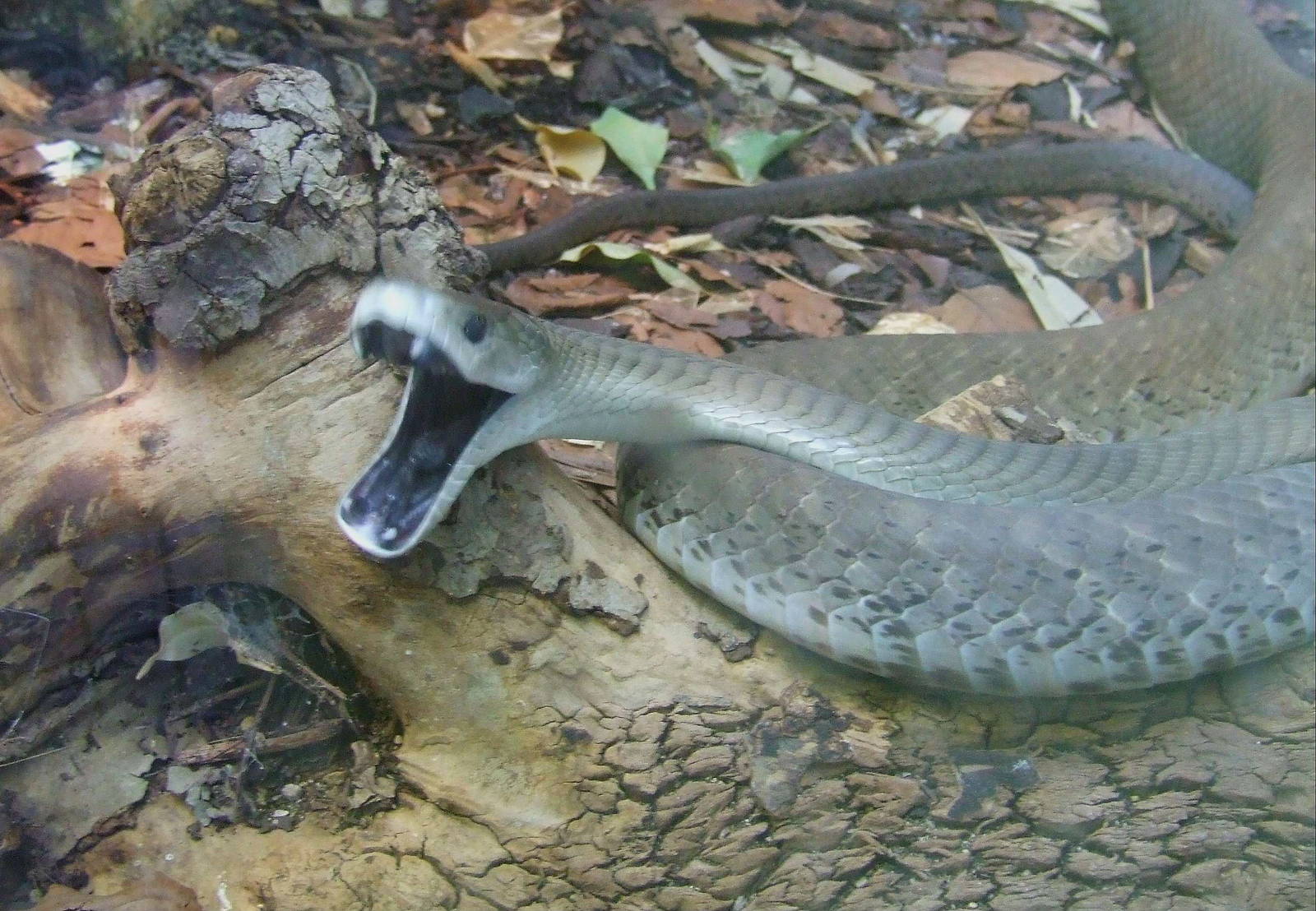
black mamba (Dendroaspis polylepis) is the longest venomous snake in Africa, averaging around 2.5 meters (8.2 ft), and sometimes growing up to 4.3 meters (14 ft). Its name is derived from the black colouration inside the mouth rather than the actual colour of the skin which varies from dull yellowish-green to a gun-metal grey. It is the fastest snake in the world, capable of moving at 4.32 to 5.4 metres per second (16–20 km/h, 10–12 mph). black mamba's back skin colour is olive, brownish, gray, or sometimes khaki. The adult snake's length is on average 2.5 meters (8.2 ft) but some specimens have reached lengths of 4.3 to 4.5 meters (14 to 15 ft). Black mambas weigh about 1.6 kilograms (3.5 lb). on average. The species is the second longest venomous snake in the world, exceeded in length only by the king cobra. black mamba lives in Africa, occupying the following range: Northeast Democratic Republic of the Congo, southwestern Sudan to Ethiopia, Eritrea, Somalia, Kenya, Eastern Uganda, Tanzania, southwards to Mozambique, Swaziland, Malawi, Zambia, Zimbabwe and Botswana to KwaZulu-Natal in South Africa, and Namibia; then northeasterly through Angola to southeastern Zaire. The black mamba is not commonly found above altitudes of 1000 metres (3280.8 feet), although the distribution of black mamba does reach 1800 metres (5905.5 feet) in Kenya and 1650 metres (5413.3 feet) in Zambia. The black mamba was also recorded in 1954 in West Africa in the Dakar region of Senegal.
 The
majority of human attacks occur in the sugarcane fields of east and
southern Africa in which are employed thousands of workers for manual
labour, as cane growing is not a highly mechanised industry.
The
majority of human attacks occur in the sugarcane fields of east and
southern Africa in which are employed thousands of workers for manual
labour, as cane growing is not a highly mechanised industry. It
is known to be capable of reaching speeds of around 20 kilometers per
hour (12 mph), traveling with up to a third of its body raised off the
ground. Over long distances the black mamba can travel 11 to 19
kilometers per hour (6.8 to 12 mph), but in short bursts it can reach a
speed of 16 to 20 kilometers per hour (9.9 to 12 mph),or even 23
kilometers per hour (14 mph) making it the fastest land snake. It is
shy and secretive; it always seeks to escape when a confrontation
occurs. If a black mamba is cornered it mimics a cobra by spreading a
neck-flap, exposing its black mouth, and hissing.
It
is known to be capable of reaching speeds of around 20 kilometers per
hour (12 mph), traveling with up to a third of its body raised off the
ground. Over long distances the black mamba can travel 11 to 19
kilometers per hour (6.8 to 12 mph), but in short bursts it can reach a
speed of 16 to 20 kilometers per hour (9.9 to 12 mph),or even 23
kilometers per hour (14 mph) making it the fastest land snake. It is
shy and secretive; it always seeks to escape when a confrontation
occurs. If a black mamba is cornered it mimics a cobra by spreading a
neck-flap, exposing its black mouth, and hissing. Some
of the components of the venom have a much more toxic LD50 value than
the venom as a whole, for example α-dentrotoxin (or "Toxin 1") and
γ-dendrotoxin (or "Toxin 7") had subcutaneous LD50 values of 0.09 µg and
0.12 µg per gram of white mice, respectively. Although only 10 to 15
mg is deadly to a human adult, its bite delivers about 100–120 mg of
venom on average but they can deliver up to 400 mg of venom in a single
bite. It is reported that before the antivenom was widely available, the
mortality rate from a bite was 100 Black mamba bites can potentially
kill a human within 20 minutes or less depending on the nature of the
bite and the area bitten, but death usually occurs after 30–60 minutes
on average, sometimes even taking up to three hours. British wildlife
enthusiast Nathan Layton was bitten by a juvenile black mamba and died
within minutes.
Some
of the components of the venom have a much more toxic LD50 value than
the venom as a whole, for example α-dentrotoxin (or "Toxin 1") and
γ-dendrotoxin (or "Toxin 7") had subcutaneous LD50 values of 0.09 µg and
0.12 µg per gram of white mice, respectively. Although only 10 to 15
mg is deadly to a human adult, its bite delivers about 100–120 mg of
venom on average but they can deliver up to 400 mg of venom in a single
bite. It is reported that before the antivenom was widely available, the
mortality rate from a bite was 100 Black mamba bites can potentially
kill a human within 20 minutes or less depending on the nature of the
bite and the area bitten, but death usually occurs after 30–60 minutes
on average, sometimes even taking up to three hours. British wildlife
enthusiast Nathan Layton was bitten by a juvenile black mamba and died
within minutes.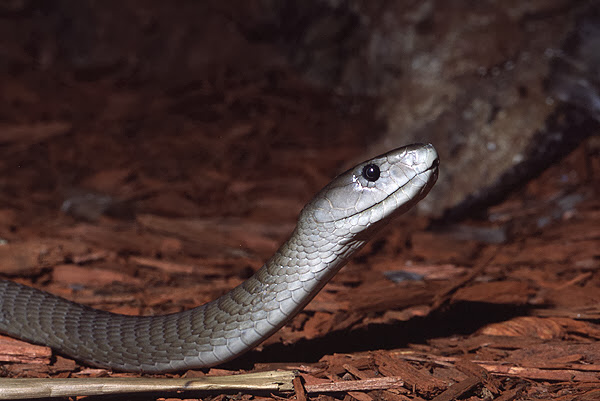 The
fatality duration and rate depend on various factors, such as the
health, size, age, psychological state of the human, the penetration of
one or both fangs from the snake, amount of venom injected, location of
the bite, and proximity to major blood vessels. In extreme cases, when
the victim has received a large amount of venom, death can result within
minutes from respiratory or cardiac arrest. This is especially true if
the victim is bitten in the face or chest area, as a black mamba can
rear up around one-third of its body from the ground which puts it at
about four feet high. When warding off a threat, the black mamba
delivers multiple strikes, injecting large amounts of virulently toxic
venom with each strike, often landing bites on the body or head, unlike
other snakes.
The
fatality duration and rate depend on various factors, such as the
health, size, age, psychological state of the human, the penetration of
one or both fangs from the snake, amount of venom injected, location of
the bite, and proximity to major blood vessels. In extreme cases, when
the victim has received a large amount of venom, death can result within
minutes from respiratory or cardiac arrest. This is especially true if
the victim is bitten in the face or chest area, as a black mamba can
rear up around one-third of its body from the ground which puts it at
about four feet high. When warding off a threat, the black mamba
delivers multiple strikes, injecting large amounts of virulently toxic
venom with each strike, often landing bites on the body or head, unlike
other snakes. The
dendrotoxins disrupt the exogenous process of muscle contraction by
means of the sodium potassium pump. Toxin K is a selective blocker of
voltage-gated potassium channels Toxin 1 inhibits the K+ channels at the
pre and post-synaptic level in the intestinal smooth muscle. It also
inhibits Ca2+-sensitive K+ channels from rat skeletal muscle‚
incorporated into planar bilayers (Kd = 90 nM in 50 mM KCl) Toxin 3
inhibits M4 receptors, while Toxin 7 inhibits M1 receptors. The
calciseptine is a 60 amino acid peptide which acts as a smooth muscle
relaxant and an inhibitor of cardiac contractions.
The
dendrotoxins disrupt the exogenous process of muscle contraction by
means of the sodium potassium pump. Toxin K is a selective blocker of
voltage-gated potassium channels Toxin 1 inhibits the K+ channels at the
pre and post-synaptic level in the intestinal smooth muscle. It also
inhibits Ca2+-sensitive K+ channels from rat skeletal muscle‚
incorporated into planar bilayers (Kd = 90 nM in 50 mM KCl) Toxin 3
inhibits M4 receptors, while Toxin 7 inhibits M1 receptors. The
calciseptine is a 60 amino acid peptide which acts as a smooth muscle
relaxant and an inhibitor of cardiac contractions.


0 comments:
Post a Comment